

If you run a business in the UAE, keeping up with Corporate Tax rules isn’t just something you do at year-end. It’s become a big part of day-to-day operations. These days, companies need to keep solid accounting records, all their supporting documents, and accurate tax calculations to stay on the right side of the law.
Getting ready for a Corporate Tax audit is more than just sending in your tax return. You need to keep your financial records organized all year—if you don’t, you risk late penalties, messy compliance notices, or trouble when the Federal Tax Authority shows up to check things out.
At Audit Firms in Dubai, we work with businesses to improve their financial compliance, keep their accounts in order, and make sure they’re ready for Corporate Tax audits across the UAE.
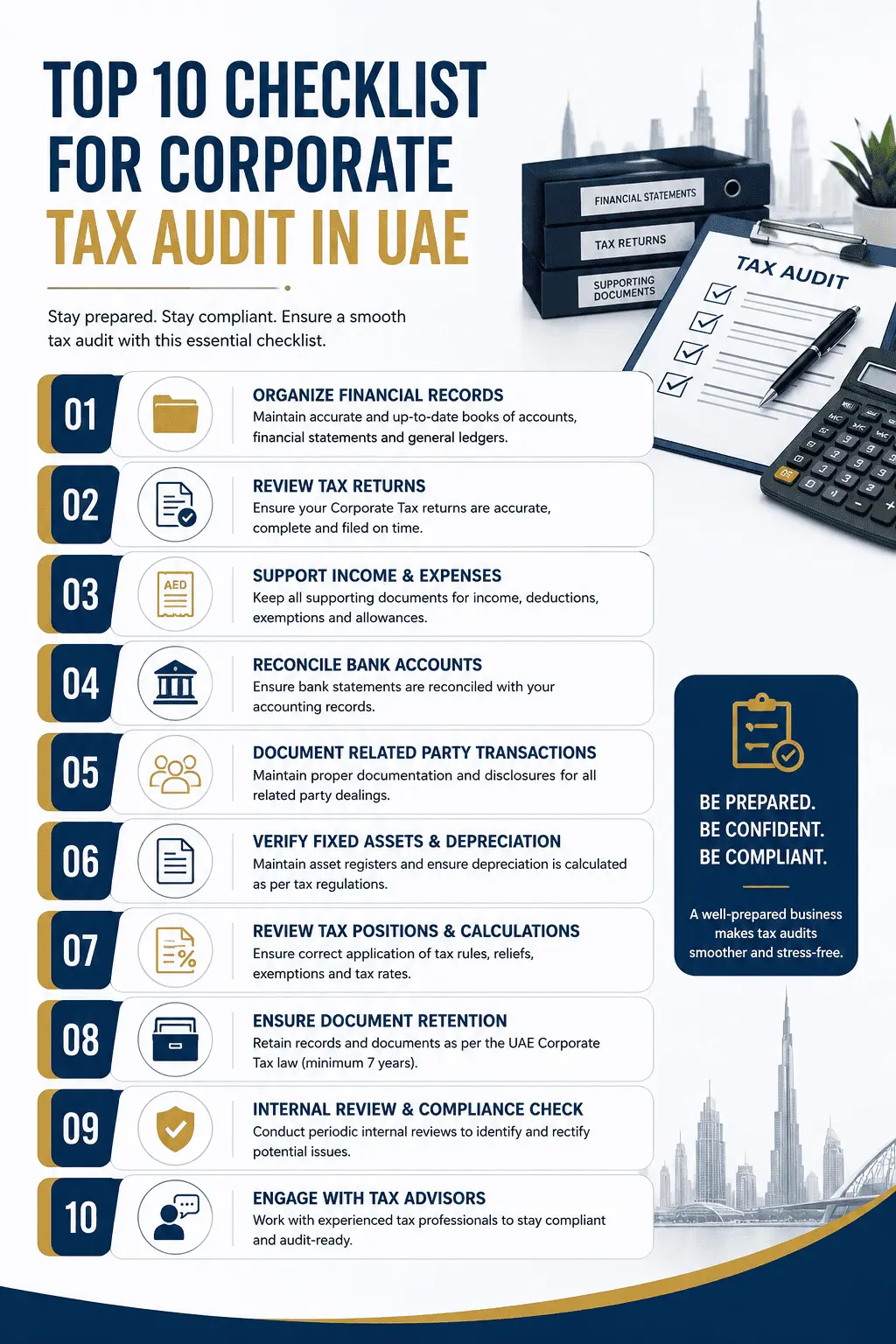
Your Corporate Tax Audit Checklist
1. Keep Financial Statements Up-to-Date
Throughout the year, keep your financial statements current. Auditors or authorities can ask to look at them any time.
- Prepare profit and loss statements that clearly show your business’s income, expenses, and net profit for each accounting period.
- Update your balance sheets so they accurately show assets, debts, and shareholder equity.
- Organize your trial balance and general ledger reports—auditors love to compare these to your tax filings.
- Review your financial statements regularly. That way, you can catch and fix any mistakes before it’s time to file your taxes.
2. Hold Onto All Invoices and Receipts
Supporting documents are your safety net. If the authorities ask for proof of a sale, an expense, or a claim, you need to have it ready.
- Keep every sales invoice. Your reported revenue should line up exactly with these documents.
- Don’t lose your purchase invoices and supplier bills. You’ll need them to back up your business costs.
- Hang onto payment receipts, vouchers, and transaction references. When audit time comes, you’ll be glad you did.
- Store your documents securely—digital or paper, just as long as you can access them when needed.
3. Double-Check Revenue Reporting
Before filing your Corporate Tax return, make sure your revenue figures are right.
- Make sure sales invoices match your accounting entries and bank deposits. Every dirham should be accounted for.
- Stay on top of cash sales—they’re easy to forget, but missing them can land you in hot water.
- Clearly split taxable income from exempt income, so your tax calculations don’t go off track.
- Check records of customer payments and outstanding receivables for accuracy.
4. Confirm Business Expenses
You want your expense claims to pass scrutiny, so take a close look.
- Review your operational expenses to be sure they’re directly related to business activities.
- Keep receipts and invoices for all significant spending—no backup, no tax deduction.
- Separate any personal expenses from business expenses. Mixing the two can really mess up your taxable profit.
- Identify expenses that aren’t deductible before you finalize your tax return.
5. Review Corporate Tax Calculations
Go over your taxable income calculations before sending your return.
- Reconcile your accounting profit with taxable profit—sometimes Corporate Tax rules require you to make adjustments.
- Check that all deductions are allowed under UAE law.
- Look over depreciation calculations and asset adjustments—they can make a big difference to your taxable profit.
- Maintain clear schedules that show exactly how you arrived at your final numbers.
6. Record Related Party Transactions Properly
If you’re dealing with related businesses, shareholders, or directors, transparency is non-negotiable.
- Keep agreements and invoices for every related-party deal.
- Have your transfer pricing documentation in order to show you used fair market values.
- Log shareholder and director transactions separately.
- Keep all payment records and supporting documents for intercompany transactions.
Businesses should also review intercompany current accounts, debit balances, and financing arrangements between related entities. In many group structures, funds regularly move between companies without formal agreements or clear commercial terms. Under UAE Corporate Tax and Transfer Pricing principles, such arrangements may potentially be viewed as financing transactions requiring appropriate documentation and arm’s length consideration, particularly where balances remain outstanding for extended periods.
7. Stay on Top of Bank Reconciliations
Double-check your records against your bank statements, and do this often.
- Match bank transactions with accounting entries. Every payment and deposit should be accounted for.
- Regularly review outstanding transactions and chase down unreconciled balances.
- Fix duplicate or missing transactions quickly to keep your records clean.
8. Maintain Payroll and Employee Records
Employee costs are a major part of your reporting, and you need full backup.
- Keep salary records, contracts, and payroll reports tidy and accessible.
- Organize Wage Protection System (WPS) records and other employee payment details.
- Log bonuses, allowances, and reimbursements accurately.
- Check your payroll entries against your accounts and bank records.
9. Organize Contracts and Legal Papers
Legal and business documents often come up during an audit.
- Store all lease agreements, supplier contracts, customer agreements, and import/export records.
- Make sure loan agreements and financing documents are always on hand.
- Keep everything signed and in a safe, easily accessible place.
Companies operating through holding structures or multiple related entities should also maintain updated organizational charts, shareholder registers, and ownership records that clearly show both direct and indirect ownership relationships. During Corporate Tax reviews or Transfer Pricing assessments, businesses may be required to demonstrate transparency of group structures and related-party relationships beyond the legal entity level.
10. Keep Up with Filing Deadlines
Late filings or missing docs can lead to fines or delays.
- Set up a compliance calendar with all important dates.
- Check previous filings and paperwork before preparing new returns.
- Finish all your reconciling before you submit your Corporate Tax filing.
- Run internal reviews from time to time to catch missing records or other issues early.
Common Corporate Tax Audit Mistakes
A lot of problems during audits come down to sloppy record-keeping and bad habits. Some of the usual suspects:
- Missing invoices or receipts
- Falling behind on bookkeeping
- Mixing up business and personal expenses
- Forgetting bank reconciliations
- Making mistakes in tax calculations
- Weak or missing supporting documents
- Incomplete financial records
The businesses that organize their paperwork and keep solid records year-round always fare better when the auditors knock.
Why You Should Prepare for a Corporate Tax Audit
Getting ready for an audit isn’t just about avoiding fines. It gives you:
- Better financial transparency
- Lower compliance risks
- Fewer penalties
- Cleaner accounting systems
- Confidence when the Federal Tax Authority reviews your business
At Audit Firms in Dubai, we help businesses stay on top of Corporate Tax, boost financial reporting, and feel ready for any audit across the UAE.
Related Audit and Tax Services
- Tax Audit Services
- FTA Audit Support
- Compliance Audit Services
- Accounting & Bookkeeping Services
- Internal Audit Services
- How to Conduct Statutory Audit in UAE
- How to Prepare for an External Audit | Process & Steps
- The Importance of Annual Audits for Businesses in Dubai
Contact Us
For assistance with Corporate Tax Audit, financial compliance, bookkeeping support, and audit preparation in the UAE, you may contact us for professional guidance.
Final Thoughts
Corporate Tax audits don’t have to be stressful. If you stay organized, keep your books accurate, and follow a good checklist, you cut down on compliance risks and keep things smooth if the Federal Tax Authority calls. Businesses with solid bookkeeping, well-kept documents, and precise tax calculations always stand on firmer ground during audits in the UAE.
Get a Quote
Ready to get started?
Contact us today to schedule a consultation and take the first step towards achieving your financial goals.
Get a QuoteFAQs
Businesses should maintain proper financial statements, sales invoices, purchase invoices, bank statements, payroll records, contracts, tax calculations, and supporting accounting documents. These records help businesses justify financial transactions and support Corporate Tax filings during audits.
Bank reconciliations help businesses verify that accounting records match actual bank transactions. Proper reconciliations help identify missing entries, duplicate transactions, incorrect balances, and financial discrepancies before audits or tax filing.
Businesses should review accounting records regularly throughout the financial year instead of waiting until tax filing deadlines. Monthly or quarterly reviews help identify bookkeeping errors, missing documents, and tax calculation issues early.
Supporting invoices help businesses prove revenue transactions, operational expenses, and tax deduction claims during compliance reviews. Missing invoices or weak documentation may create audit concerns and increase the risk of penalties.
Businesses can prepare for Corporate Tax audits by maintaining organized financial statements, accurate bookkeeping records, reconciled bank accounts, proper tax calculations, and complete supporting documentation throughout the year.